
PL01
Senior Software Engineer
Design and lead organization-scale software development, from architecture to system quality.
CPL01 Able to analyze, design, and develop modern software solutions based on user needs.
Academics

 raharja.ac.id ↗
At a glance
Final project is taken in semester 4 after passing all other courses in the curriculum. The curriculum is evaluated every three years.
Graduate direction
Each profile has one main program learning outcome (PLO / CPL). CPL05, on research and publication, applies to all graduates.
PL01
Design and lead organization-scale software development, from architecture to system quality.
CPL01 Able to analyze, design, and develop modern software solutions based on user needs.

PL02
Build data and artificial intelligence models used for decision-making.
CPL02 Able to develop and evaluate artificial intelligence and data science models for decision-making.

PL03
Align information technology with organizational strategy and guide digital transformation.
CPL03 Able to design innovative information technology strategies and solutions for organizational digital transformation.

PL04
Lead ICT projects with attention to quality, risk, and governance.
CPL04 Able to manage ICT projects based on quality standards, risk management, and governance.
CPL05 · all profiles
Able to produce reputable publications and technological innovations that contribute to industry and societal problems.
Graduate outcomes (OBE)
An outcome-based curriculum is measured by what graduates actually master. The 2025 tracer study asked alumni to rate the competencies they had at graduation and the level needed at work (scale 1–5).
| Aspect | Mastered at graduation | Required at work |
|---|---|---|
| Ethics | 4,18 | 4,25 |
| Subject expertise | 4,18 | 4,18 |
| English | 3,75 | 3,89 |
| Use of IT | 4,32 | 4,29 |
| Communication | 4,29 | 4,32 |
| Teamwork | 4,39 | 4,43 |
| Self-development | 4,36 | 4,36 |
Field expertise and IT → CPL01–CPL04
Mastery scores at graduation of 4.18 (field expertise) and 4.32 (IT use) already match job requirements.
Ethics, communication, teamwork → leadership and attitude
Scores of 4.18–4.39, in line with a graduate profile that leads ICT teams and projects.
English → CPL05 publication
The largest gap is in English: 3.75 at graduation versus 3.89 needed at work. Applicants take the RCEP English test during admission selection.
Ethics, communication, and teamwork are also slightly below what is needed (a gap of 0.03–0.07). The link between these competencies and the PLOs is the study program's reading of the tracer results.
Structure
Select a course to see its description, outcomes, and learning documents (RPS and learning materials per meeting). Badges show the group: D1 core and distinctive, D2 domain and application, D3 analysis methods.
Foundations: software engineering, IT management, digital entrepreneurship, and current issues.
Data and research: data warehousing, project management, research methodology, and scientific writing.
Application: AI for business, data engineering, cybersecurity, and the thesis proposal.
Final project: research and one form of final project output.
Semester 4 contains MT345 Research and Thesis and the four final project forms (MT441–MT444). See the final project flow.
Study materials
Study materials are the fields of knowledge that make up course content. The ten study materials are grouped into four themes.
Preparation
Besides university, faculty, and study program leadership and the lecturer team, the curriculum is discussed with the following external parties. The curriculum is evaluated every three years.
Industry
PT Patama Adijaya Steel
Professional association
APTIKOM Banten
Government
Tangerang City Government
Certification body
National Professional Certification Agency (BNSP)
Partner universities
Universitas Islam Syekh-Yusuf
Documentation
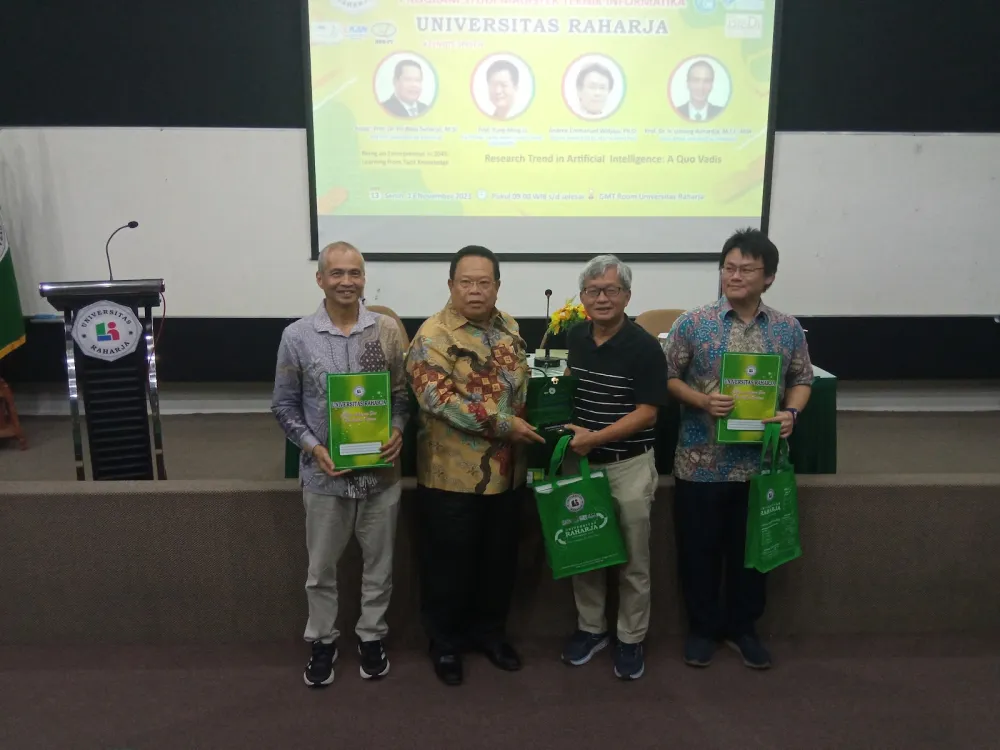
The Universitas Raharja faculty meeting on curriculum evaluation, a public lecture, and the MTI S2 midterm exam, from the PR documentation.
Documents

MiRa - MTI
Online
Verified MTI information in seconds. Type a question or select a topic.
Answers are grounded in official MTI Universitas Raharja data.